When running large email campaigns, choosing the right infrastructure is critical for deliverability. You have two main options: shared or dedicated email infrastructure. Here's the quick breakdown:
Key Considerations:
Quick Comparison:
| Factor | Shared Infrastructure | Dedicated Infrastructure |
|---|---|---|
| Reputation Control | Shared among users | Fully isolated |
| Volume Capacity | Under 100,000 emails/month | Over 300,000 emails/month |
| Setup Complexity | Immediate, pre-warmed IPs | 2–4 week warm-up required |
| Cost | $2.49–$15/month | $100–$250/month (IP only) |
| Maintenance | Minimal, provider-managed | High, requires active oversight |
Your choice depends on your email volume, budget, and technical resources.

Shared vs Dedicated Email Infrastructure Comparison Chart
Shared email infrastructure allows multiple users to send emails using the same server resources and IP addresses. Imagine it like living in an apartment building where everyone shares the same street address - the reputation of the entire building depends on how its residents behave collectively.
Shared IPs rely on a pooled reputation, which can help new users start sending emails immediately. However, there's a risk: one sender's poor behavior can affect everyone. As Disha Bhatt, Content Strategist at Email Uplers, puts it:
"As evident from the name, a shared IP address gets shared between you and several other senders. It facilitates deliverability by bringing together everyone's IP reputation."
Here are some key aspects that make shared email infrastructure appealing:
This setup is ideal for businesses sending fewer than 100,000 emails per month.
The Klaviyo Help Center explains:
"Shared IPs are intended for use by small senders that don't send on a regular cadence. The reasoning for this is that the small senders can band together to create a reputation."
The biggest draw of shared infrastructure is its immediate availability. You can launch email campaigns right away - no waiting weeks for an IP warmup. This is a game-changer for startups and small teams experimenting with cold email tools for small businesses.
The low cost is another major plus. At just $2.49–$15 per month, even businesses with tight budgets can access professional-grade email infrastructure without needing extensive technical resources.
For example, in 2025, UniteSync used Mailforge's shared infrastructure alongside Salesforge to achieve a 17% reply rate and maintain a response rate above 50%, all while reducing customer acquisition costs to $2.86.
However, shared infrastructure isn't without its challenges.
One of the biggest risks with shared infrastructure is the lack of control over your email reputation. If another sender in the shared pool gets flagged for bad behavior - such as spam complaints or deliverability issues - it could impact your performance too. Ryan Steen, Senior Deliverability Strategist at Klaviyo, cautions:
"If other senders in the pool experience a sudden drop in performance (blocks, throttling, etc.), it can impact your performance as well."
Another downside is the inability to customize authentication settings or isolate your reputation from others in the pool. This makes it crucial to choose an ESP that actively monitors its shared pools and quickly removes problematic users. Keeping spam complaints below 0.3% is also essential to avoid being flagged by filters. Without proper infrastructure, only 1 in 40 cold emails typically bypasses spam folders.
While Mailforge's shared infrastructure offers quick setup and affordability, maintaining strong deliverability requires vigilance and ongoing monitoring.
(function(d,u,ac){var s=d.createElement('script');s.type='text/javascript';s.src='https://a.omappapi.com/app/js/api.min.js';s.async=true;s.dataset.user=u;s.dataset.campaign=ac;d.getElementsByTagName('head')[0].appendChild(s);})(document,372145,'bgla6zdvtvvykvmfmifs');
Dedicated email infrastructure gives your organization full control over its email servers and resources. Think of it like owning a private highway - you decide the traffic flow and maintain the road's reputation. This level of control is a stark contrast to shared setups, where multiple users rely on the same resources.
The standout feature of dedicated infrastructure is exclusive IP addresses. These act as unique digital return addresses for your emails. With dedicated IPs, your sender reputation is entirely based on your actions, not influenced by others sharing the same system. This isolation is crucial for maintaining a clean reputation. As Ketevan Bostoganashvili, Technical Content Writer at Mailtrap, puts it:
"Your server IP reputation directly impacts email deliverability whether you send transactional emails or carefully-planned email marketing campaigns."
Dedicated infrastructure is tailored for high-volume senders, typically those handling 300,000 or more emails per month. It's especially suited for organizations sending between 500,000 to 1 million emails monthly and those with strict security or compliance needs. Enterprise teams often choose this setup to meet stringent security, regulatory compliance, and advanced authentication requirements. Industries like finance and healthcare rely on dedicated infrastructure to manage sensitive data and comply with regulations such as GDPR and HIPAA.
When setting up a new dedicated IP, there’s a 2 to 4 week warmup period. During this time, email volume is gradually increased to build trust with major ISPs. Keep in mind, most reputation systems only store data for 30 days. If your IP remains inactive for longer, you'll need to repeat the warmup process.
Dedicated infrastructure stands out by offering unmatched control over your email operations. Here's a closer look at the key features that make it a powerful choice for businesses managing high email volumes.
One of the biggest advantages is complete control over your IP reputation. With no shared resources or external influences, your digital identity is entirely your own. This means the outcomes - good or bad - are directly tied to how you manage your email practices. Keep your lists clean and maintain consistent sending volumes, and you'll see strong results. However, any missteps, like sending to outdated lists, could hurt your reputation, and you'll bear the consequences alone.
Advanced authentication protocols are another cornerstone of dedicated setups. These include SPF (which authorizes specific IPs to send on behalf of your domain), DKIM (which adds a digital signature to every outgoing email), and DMARC (which tells receiving servers how to handle emails that fail authentication). Together, these protocols protect your brand from spoofing and phishing attacks while building trust with major ISPs like Gmail and Yahoo. This combination not only safeguards your operations but also supports long-term deliverability.
For businesses managing high email volumes, multi-IP provisioning becomes essential. Instead of funneling all traffic through one IP, you can spread the load across multiple dedicated IPs. This setup allows you to handle different campaign types more efficiently while reducing the risk of deliverability issues. Companies sending more than 1 million emails monthly often rely on this approach to maintain consistent performance.
Dedicated infrastructure also gives you the ability to configure DNS records, set up custom bounce handling, and access detailed logs for every message sent. Daily monitoring tools like Google Postmaster Tools, SenderScore.org, and MxToolbox can help you identify and address deliverability challenges early, keeping your campaigns on track.
Finally, keeping your spam complaint rate below 0.3% is critical. Crossing this threshold can trigger spam filters, even if your authentication protocols are flawless. Considering email marketing's impressive return - an average of $36 for every $1 spent - protecting your IP reputation isn't just a technical matter; it's a financial priority too.
Dedicated infrastructure gives you complete control over your IP reputation by isolating it to your own sending habits. As the Klaviyo Help Center explains:
"The main benefit of using a dedicated IP address is that the reputation of the IP address can only be influenced by the single account that is using it".
This level of control provides a solid foundation for consistent and reliable email performance.
With dedicated infrastructure, you can count on predictable deliverability. If an issue arises, you won't have to wonder if someone else's campaign caused a problem - it's all under your control. This ability to pinpoint and resolve issues quickly helps ensure your emails consistently land in inboxes, which is especially critical for businesses that rely on email to drive revenue.
For high-volume senders - those sending over 100,000 emails per month - dedicated setups are particularly effective. They can handle large sending spikes and allow for multi-IP provisioning to better manage traffic. Experts strongly recommend dedicated IPs for senders operating at this scale.
Another advantage is the freedom to control your sending pace. Unlike shared infrastructure, where limits are dictated by collective activity, dedicated systems let you scale up during peak campaigns without restrictions. This means you can maintain a steady sending cadence, even during periods of high demand.
The stakes are high when it comes to email deliverability. With around 14.5 billion emails flagged as spam every day - nearly half of all global email traffic - protecting your reputation is essential. Dedicated infrastructure makes it easier to keep your spam complaint rate below 0.3%, a critical threshold for avoiding disruptions to your campaigns. When you're the only one influencing your metrics, maintaining a strong reputation becomes far more manageable.
While dedicated infrastructure gives you complete control, it comes with hefty costs. For instance, a dedicated IP can set you back anywhere from $100 to $250 per month, compared to the much cheaper $2.49–$15 for shared infrastructure. And that’s just the beginning - setup fees often start at $1,200, and hiring a dedicated email administrator could mean an annual salary of $80,000 to $100,000.
The technical demands are no joke either. Carin Slater, Manager of Lifecycle Email Marketing at Litmus, emphasizes the importance of staying on top of every detail:
"Deliverability is a measure of the health of your email marketing program, so it's important to do regular check-ups on your domain, IP, and authentication in particular to make sure you're up-to-date".
Managing a dedicated infrastructure means mastering SPF, DKIM, and DMARC protocols while keeping a close eye on bounce rates, blacklist status, and spam complaint rates, which must stay below 0.3%. This level of oversight adds significant operational challenges.
Another major drawback? You must send emails consistently - and in large volumes. Dedicated infrastructure is best for businesses sending over 300,000 emails per month, though some experts suggest 1 million emails is the real threshold to make it worthwhile. Reputation systems only retain data for about 30 days, so if your email activity drops for more than a month, you’ll have to start the 2-to-4-week warmup process all over again.
The reputation risk is also entirely on you. Any irregular sending patterns, sudden spikes in email volume, or high bounce rates can severely damage your IP's reputation with ISPs. Unlike shared infrastructure, where the impact of mistakes is spread across many users, a misstep on a dedicated IP can cripple your entire email program. And fixing it? Both challenging and expensive.
To make sense of the differences between shared and dedicated infrastructure, here’s a straightforward comparison. The decision often boils down to how much email your business sends, the level of control you need, and the resources available. Shared infrastructure is generally suitable for businesses sending fewer than 100,000 emails per month, while dedicated setups are tailored for high-volume senders exceeding 300,000 emails monthly. They also vary significantly in terms of cost and technical requirements.
One major distinction lies in reputation management. With shared infrastructure, sender reputation is pooled across multiple users, and the provider takes care of most of the oversight. On the other hand, dedicated infrastructure isolates reputation to your account alone. This gives you full control but also means you’re entirely responsible for maintaining it.
Another key factor is setup complexity. Shared IPs are pre-warmed and ready to use immediately, making them a great choice for businesses that need to hit the ground running. Dedicated IPs, however, require a warm-up period of 2–4 weeks, during which sending volume must be gradually increased. Skipping this step can severely impact your email deliverability.
The amount of operational effort also varies widely. Shared infrastructure requires minimal maintenance since the provider handles deliverability, IP reputation, and technical configurations. In contrast, dedicated infrastructure demands ongoing monitoring of metrics like bounce rates, spam complaints (which need to stay below 0.3%), blacklist statuses, and authentication protocols like SPF, DKIM, and DMARC.
Here’s a quick table summarizing the main differences:
| Factor | Shared Infrastructure | Dedicated Infrastructure |
|---|---|---|
| Reputation Control | Shared among users; managed by provider | Fully isolated; entirely your responsibility |
| Volume Capacity | Best for under 100,000 emails/month | Ideal for over 300,000 emails/month |
| Setup Complexity | Immediate; pre-warmed IPs | Requires 2–4 week warm-up |
| Maintenance | Minimal; provider-managed | High; requires active monitoring |
| Cost | $2.49–$15/month | $100–$250/month (IP only) |
| Scalability | Managed by provider | Requires manual resource scaling |
| Security & Authentication | Limited; provider-dependent | Complete control over protocols |
| Best For | Small businesses, startups | High-volume senders, regulated industries |
This side-by-side comparison highlights the trade-offs between simplicity and control. Whether you prioritize ease of use or prefer having full responsibility will guide your choice.
When managing email outreach across different operations, the type of infrastructure you choose determines how quickly and efficiently you can scale. Shared and dedicated setups both support multi-workspace operations, but they differ significantly in how they handle mailbox provisioning, DNS automation, and domain management.
The main distinction lies in automation versus control. Shared infrastructure automates most of the technical processes, allowing you to deploy hundreds of mailboxes in minutes. On the other hand, dedicated infrastructure gives you full control over every detail but requires manual setup and ongoing maintenance. Let’s dive into how each option scales in a multi-workspace environment.
Shared infrastructure is designed for simplicity and speed, making it a great choice for scaling across multiple workspaces. With this setup, the provider takes care of IP reputation, DNS configurations, and mailbox warmup automatically. This means you can quickly add mailboxes and domains without dealing with complex technical tasks - a huge advantage when you need to distribute email volume across various workspaces in a short time.
One standout feature is automated DNS setup, which removes the need to manually configure SPF, DKIM, and DMARC records for each domain. Bulk DNS updates allow you to make changes across hundreds of domains at once, saving time and effort. Additionally, shared infrastructure often includes pre-warmed IPs, so your mailboxes are ready to send emails immediately, bypassing the typical 28-day warmup period required in dedicated setups. This makes it an excellent option for agencies or teams managing multiple clients and campaigns that need to launch quickly without heavy technical involvement.
Dedicated infrastructure, on the other hand, focuses on providing complete control and scalability through multi-IP provisioning and advanced authentication protocols. If your email volume exceeds 300,000 messages per month across workspaces, this setup offers predictable deliverability since your reputation isn’t impacted by other senders. It’s a control-first approach, aligning with the needs of high-volume senders or those in regulated industries.
However, scaling with dedicated infrastructure requires a significant technical investment. Every new IP goes through a 28-day warmup process, starting at 20 emails per hour and gradually increasing. You’ll also need to manually configure DNS records for each domain, closely monitor bounce rates (keeping them under 1%), and ensure spam complaints stay below 0.3%. This setup is far from plug-and-play, demanding technical expertise to maintain.
As Carin Slater, Manager of Lifecycle Email Marketing at Litmus, points out:
"Deliverability is a measure of the health of your email marketing program, so it's important to do regular check-ups on your domain, IP, and authentication".
The key advantage of dedicated infrastructure lies in its isolation and predictability. By keeping your sender reputation fully under your control, it’s ideal for industries or campaigns where deliverability is critical and cannot be compromised. However, this added control comes with the requirement of having a dedicated technical team to manage the setup across multiple workspaces.
When scaling email infrastructure for multiple workspaces, the financial differences between shared and dedicated setups are striking. Shared infrastructure typically costs between $2.49 and $15 per month per mailbox, with minimal setup fees. On the other hand, dedicated infrastructure requires a hefty upfront investment of $1,200 or more, along with monthly fees ranging from $100 to $250 per IP.
Dedicated setups also come with additional staffing costs. Hiring email administrators, whose salaries range from $80,000 to $100,000 annually, is often necessary. Shared infrastructure, however, spares businesses this expense, as the provider manages all technical aspects. Considering that email marketing delivers an average return of $36 for every $1 spent, any failure in deliverability could have serious financial consequences.
A real-world example underscores this point. In June 2022, Litmus faced a drop in inbox placement rates, falling from 98–99% to below 90% due to Gmail reputation issues. To recover, they paused risky automations and focused on re-engaging their most active subscribers to regain Gmail's trust. This incident highlights how reputation issues can significantly impact revenue, regardless of the chosen infrastructure.
Beyond these financial considerations, the level of management required also sets these two options apart.
While cost is a key factor, the operational demands of shared versus dedicated infrastructure reveal another layer of complexity. Shared infrastructure is largely hands-off. The provider takes care of server security, anti-spam measures, DNS configurations, and compliance protocols. Additionally, shared mailboxes are pre-warmed and ready to send right away, requiring no technical setup.
Dedicated infrastructure, however, demands ongoing attention. Dedicated IPs need a 2-to-4-week warmup period before they can be fully utilized. Daily monitoring for blacklists and spam complaints - keeping them under 0.3% - is crucial. Carin Slater, Manager of Lifecycle Email Marketing at Litmus, emphasizes the importance of this oversight:
"Deliverability is a measure of the health of your email marketing program, so it's important to do regular check-ups on your domain, IP, and authentication in particular to make sure you're up-to-date".
This hands-on management means businesses must either build an in-house team or invest in expert consultants. The choice between shared and dedicated infrastructure ultimately boils down to balancing control with ease of use. Each option comes with its own set of trade-offs.
Deciding between shared and dedicated infrastructure boils down to your email volume, technical know-how, and specific business needs. Each option serves different purposes, so understanding your requirements is crucial. Let’s break down when each model works best.
If your email volume is under 100,000 emails per month, shared infrastructure is a great fit. It’s particularly suited for startups, small teams, or businesses experimenting with cold outreach campaigns. Shared infrastructure handles DNS, reputation management, and compliance for you, making it a plug-and-play solution. Plus, shared mailboxes come pre-warmed, so you can start sending emails right away - no need for the 2–4 week warm-up required for dedicated IPs. This makes it an excellent choice for seasonal or irregular email campaigns.
Cost is another big advantage. Shared hosting typically ranges from $2.49 to $15 per month per mailbox, which means you avoid the upfront costs and ongoing maintenance expenses tied to dedicated setups. As Kostas Zhukov, Founder & CEO of ChatPoint, puts it:
"When it comes to cold email infrastructure setup, Mailforge provides 100x improvement! Procedures that usually took hours... now take a few minutes."
This simplicity makes shared infrastructure a go-to option for smaller-scale or short-term needs.
If your email volume exceeds 300,000 emails per month or email plays a critical role in driving revenue, a dedicated infrastructure is likely the better choice. It gives you full control over your IP reputation by isolating it from other users, which is essential for large-scale operations. Industries like finance and healthcare, which require strict compliance and security measures, often rely on dedicated setups for their advanced configurations and whitelisting capabilities.
However, these benefits come with added complexity. Dedicated infrastructure requires technical expertise to manage tasks like manual IP warm-up, blacklist monitoring, and keeping spam complaint rates below 0.3%. It’s also more expensive. Initial setup fees can start at $1,200, with ongoing monthly IP fees ranging from $100 to $250. Staffing costs for managing the setup can add up too, with salaries for specialists typically falling between $80,000 and $100,000 per year.
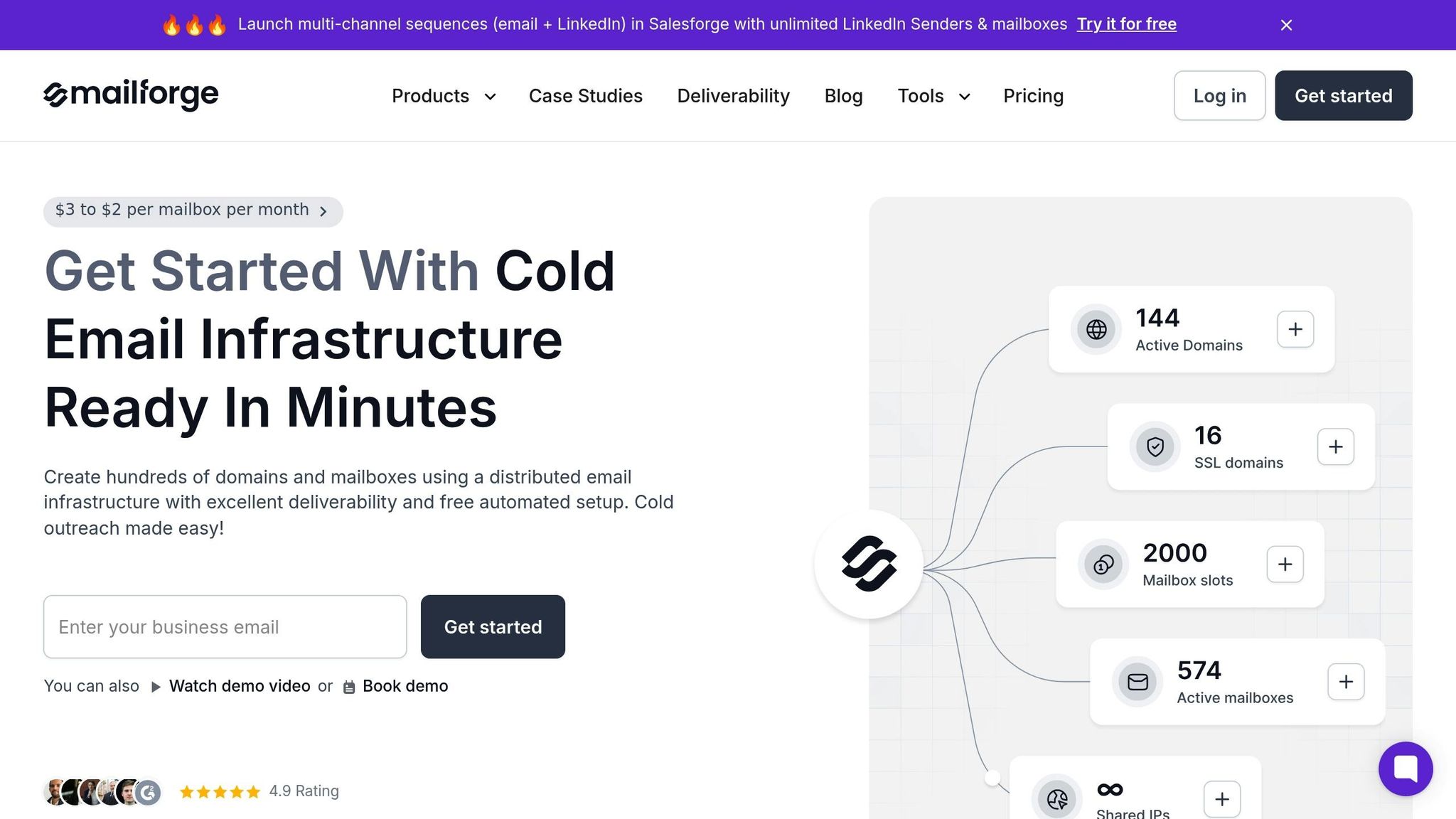
For businesses opting for shared infrastructure but needing scalability, Mailforge offers a tailored solution. Designed for rapid growth, Mailforge lets you manage hundreds or thousands of domains and mailboxes in just minutes. Features like automated DNS setup and premium deliverability ensure you can scale without the headaches of a dedicated setup.
Mailforge plans start at $30 per month for 10 mailbox slots (or $25 per month if billed annually), with a 10-slot minimum. Domain pricing depends on the TLD - for example, five ".com" domains cost $70 per year. Additional features like SSL and domain masking are available for $2 per domain per month (or $6 per domain per year).
For businesses that eventually outgrow shared infrastructure, Infraforge offers dedicated solutions. It includes advanced features like multi-IP provisioning and API access. Plus, it integrates seamlessly with other Forge Stack tools, such as Salesforge for outreach and Warmforge for deliverability, ensuring your infrastructure evolves alongside your business needs.
Deciding between shared and dedicated email infrastructure comes down to what fits your business needs best. If your email volume is under 100,000 per month, shared infrastructure is a practical choice. It’s affordable - costing just $2–$15 per month - and offers pre-warmed mailboxes and easy setup. On the other hand, businesses sending over 300,000 emails monthly might benefit from dedicated infrastructure. While it provides more control and isolation, it requires technical expertise and comes with higher costs, including IP fees ranging from $100–$250 per month.
With nearly half of global email traffic being flagged as spam, keeping your spam complaint rate below 0.3% is crucial. This means your infrastructure must align with your email volume and sending patterns. As Carin Slater, Manager of Lifecycle Email Marketing at Litmus, advises:
"Deliverability is a measure of the health of your email marketing program, so it's important to do regular check-ups on your domain, IP, and authentication".
For businesses that value scalability without the headaches of managing a dedicated setup, Mailforge offers a balanced solution. It simplifies DNS configuration, enhances deliverability, and allows management of multiple domains in minutes - all while keeping costs low. Plans start at $30 per month for 10 mailbox slots, making it an accessible option for growing teams.
When your needs outgrow shared infrastructure, Infraforge steps in with dedicated solutions. It provides advanced features like multi-IP provisioning and API access, ensuring your system can handle higher volumes or stricter compliance requirements. Both Mailforge and Infraforge integrate seamlessly with the broader Forge Stack, including tools like Salesforge for outreach and Warmforge for monitoring deliverability. This ensures your email infrastructure evolves alongside your business.
Ultimately, assess your email volume and technical capabilities to choose the setup that aligns with your growth. The right infrastructure can make all the difference in whether your emails land in inboxes or get lost in spam folders.
When deciding between shared and dedicated email infrastructure, it’s essential to consider factors like cost, control, and scalability. Shared infrastructure is an affordable option and easy to set up, which makes it a great fit for startups or smaller businesses. However, the downside is that your sender reputation is linked to other users on the same platform. If someone else misuses the service, it could hurt your deliverability.
On the flip side, dedicated infrastructure offers complete control over your IP reputation. This makes it the better choice for businesses running high-volume email campaigns or operating in industries with strict compliance requirements. While it involves a larger upfront cost and requires technical know-how for setup and maintenance, it delivers stronger deliverability and scalability for critical email operations.
For those looking for a quick and budget-friendly solution, shared platforms like Mailforge are excellent starting points. But if you’re planning for long-term growth, operate in a regulated industry, or need to manage large-scale campaigns, dedicated options such as Infraforge or Primeforge offer the reliability and control to meet your needs.
Warming up a dedicated IP is an essential step for achieving reliable email deliverability. This gradual process helps the IP earn a positive sending reputation with email providers by starting with small email volumes and slowly increasing them over time.
Skipping this step can lead to serious issues - emails from a new dedicated IP are far more likely to be marked as spam or even blocked altogether. A carefully managed warm-up period ensures your emails land in inboxes, building trust with email providers and making sure your campaigns reach the people they're meant for.
Shared email infrastructure comes with its fair share of risks, largely because it's a communal setup. If other users sharing the same IP address engage in spammy activities, it can damage the IP's reputation. This could hurt your email deliverability and, in some cases, even result in the IP being blacklisted.
Another drawback is the lack of control and security. Since you're relying on the policies and practices of the shared environment, you have limited ability to customize or secure your email operations. This becomes especially concerning if your business deals with sensitive or regulated data, as compliance can be harder to guarantee. For companies that value reliability and control, these are crucial factors to weigh carefully.